Get the Bambu Lab A1 if:
- You print parts bigger than 220 mm.
- You want a built-in camera.
- You want the longer US warranty from Bambu’s store.
3D printers · Comparison
The short answer
Our overall pick: the Bambu Lab A1, for its bigger build, built-in camera, per-print calibration and longer US warranty.
Bigger prints, a camera and a 2-year warranty? A1
Smaller footprint, Ethernet and quick-swap nozzles? Adventurer 5M
The A1 wins 6 spec rows to 3. It prints bigger parts (256 mm against 220 mm), has a hotter hotend, a built-in camera and more automatic calibration, weighs less and has the longer US warranty. The Adventurer 5M has double the listed acceleration, Ethernet and a narrower footprint. They move differently: the Adventurer 5M is CoreXY, while the A1 is a bed-slinger. Both are open-frame printers best kept to PLA, PETG and similar filaments.
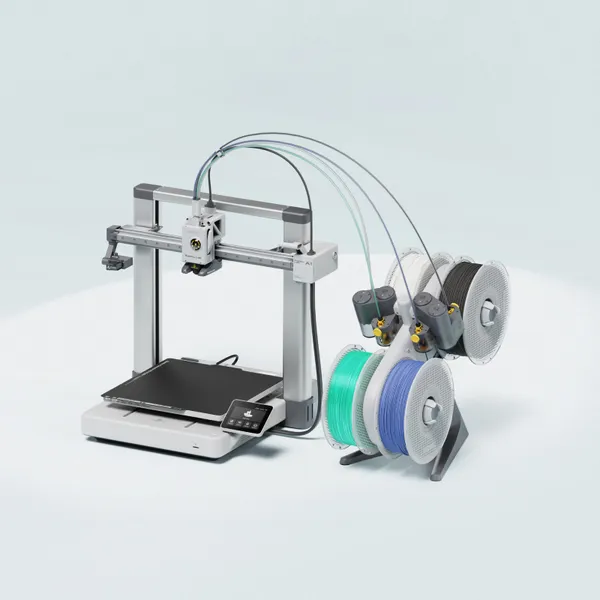
A standalone Adventurer 5M review isn’t published yet. This comparison uses Flashforge’s official US pages and manual.
Best for bigger prints
This button goes to the standalone A1 at Bambu Lab’s US store, where Bambu Lab’s 2-year US warranty applies. The AMS Lite isn’t included.
Check the A1 at Bambu (2-year US warranty)Best for a compact CoreXY
Flashforge says the seller handles after-sales service, so check the Amazon seller. Pick the Adventurer 5M, not the 5M Pro or AD5X.
See the Adventurer 5M on AmazonBefore you buy: Flashforge’s 600 mm/s is travel speed; its manual lists printing at 10–300 mm/s. The Adventurer 5M has no camera in the box, and Flashforge says ABS-series filament isn’t compatible. The standalone A1 needs the AMS Lite, sold separately, for multi-color, and Bambu Lab’s 2-year US term is written for Bambu Store purchases.
As an Amazon Associate I earn from qualifying purchases. I may also earn a commission from Bambu Lab links. Links on this page are affiliate links; it costs you nothing extra.
The A1 wins on build volume, hotend temperature, calibration, camera, weight and warranty. The Adventurer 5M wins on acceleration, connectivity and footprint.
A green check marks the clearly better spec: more than 5% apart, or a feature only one has. No check means a tie, specs stated differently, or a spec one maker doesn’t publish. Multi-color gets no check because neither includes it in the compared setup. Figures come from the makers’ US pages, the Adventurer 5M manual and both warranty policies. Numbers in brackets link to the sources below.
| Adventurer 5M | A1 | |
|---|---|---|
| Motion and frame [1] [4] | CoreXY, open frame | Bed-slinger (the bed moves on Y), open frame |
| Build volume [1] [5] | 220 x 220 x 220 mm | 256 x 256 x 256 mm |
| Speed [1] [2] [5] | 600 mm/s max travel; printing 10–300 mm/s (manual) | 500 mm/s max toolhead speed |
| Acceleration [1] [5] | 20,000 mm/s² | 10,000 mm/s² |
| Max hotend temp [1] [5] | 280°C | 300°C, all-metal hotend |
| Nozzles [1] [5] | 0.4 mm (0.25 / 0.6 / 0.8 mm optional, quick-release) | 0.4 mm stainless (0.2 / 0.6 / 0.8 mm optional) |
| Max bed temp [1] [2] [5] | 100°C (US page) or 110°C (manual) | 100°C |
| Auto calibration [1] [4] | One-click leveling, vibration compensation | Z-offset, bed leveling, vibration resonance and pressure advance on every print; belt-tension check |
| Multi-color [1] [4] [6] | None; single extruder | None in the box; optional AMS Lite (sold separately) |
| Filaments [1] [5] | PLA, PETG; TPU, PLA-CF, PETG-CF with 0.6 / 0.8 mm nozzle; ABS series not compatible | PLA, PETG, TPU, PVA ideal; ABS, ASA, PC, PA, PET and CF/GF-filled not recommended |
| Camera [1] [3] [5] | None built in (optional camera) | Built in, up to 1080p (low frame rate), timelapse |
| Sensors [1] [5] | Run-out reminder, power-loss recovery | Run-out, odometry, tangle; power-loss recovery |
| Connectivity [1] [5] | Wi-Fi, Ethernet, USB | Wi-Fi, Bambu-Bus, microSD |
| Slicer [1] [5] | FlashPrint 5, Orca-Flashforge, Orca Slicer | Bambu Studio (G-code from other slicers supported, with limits) |
| Noise [1] [4] [6] | Not published | Under 48 dB in Silent Mode (product page); store page says 49 dB |
| Size [1] [5] | 363 x 402 x 448 mm with screen | 465 x 410 x 430 mm |
| Weight [2] [5] | 10.8 kg net (manual) | 8.3 kg net |
| Setup [1] [7] | 95% pre-assembled; fit the screen and spool holder | Ships as base and frame; some assembly |
| US warranty [8] [9] | 12 months; 3 months on extruder parts; the seller handles service | 2 years for US consumers (written for Bambu Store US purchases); some parts 3 months |
Common print jobs, judged only from the makers’ build volume, filament, camera and connectivity specs.
| Job | Adventurer 5M | A1 |
|---|---|---|
| Part up to 220 mm | Can do220 mm build volume. | Can do256 mm build volume. |
| Part up to 250 mm | Can’tOver 220 mm. | Can do256 mm build volume. |
| PLA or PETG | Can doRecommended with the 0.4 mm nozzle. | Can doListed as ideal. |
| TPU | Just barelyNeeds the 0.6 or 0.8 mm nozzle. | Can doListed as ideal. |
| Carbon-fiber PLA or PETG | Just barelyListed with the 0.6 or 0.8 mm nozzle. | Can’tNot recommended by Bambu Lab. |
| PVA supports | Can’tNot on Flashforge’s list. | Can doListed as ideal. |
| ABS or ASA | Can’tABS series not compatible (US page). | Can’tNot recommended by Bambu Lab. |
| Multi-color prints | Can’tNo multi-color system. | Just barelyNeeds the AMS Lite, sold separately. |
| Watch prints by camera | Just barelyCamera is an add-on. | Can doBuilt-in camera. |
| Wired network | Can doEthernet. | Can’tNot listed. |
As an Amazon Associate I earn from qualifying purchases. I may also earn a commission from Bambu Lab links.
Skip it if you want CoreXY motion, a wired Ethernet connection or carbon-fiber-filled filament.
Skip it if your parts are bigger than 220 mm, you want a camera without buying an add-on, or you might want multi-color later.
Flashforge lists 600 mm/s as maximum travel speed and 10–300 mm/s as printing speed; its product page also calls 600 mm/s a printing speed. Bambu Lab lists 500 mm/s maximum toolhead speed. They’re stated differently, so we don’t call a winner. The Adventurer 5M lists higher acceleration: 20,000 against 10,000 mm/s².
No. The Adventurer 5M is CoreXY. The A1 is a bed-slinger: the bed moves front to back. Bambu’s “Bed Slinger with CoreXY Speed” line is a marketing claim, not a different motion system.
Not out of the box. The Adventurer 5M has no multi-color system. The standalone A1 can add the optional AMS Lite, sold separately.
Neither is a good fit. Flashforge’s US page says ABS-series filament isn’t compatible with the Adventurer 5M, and Bambu Lab lists ABS and ASA as not recommended on the open-frame A1.
The A1: Bambu Lab lists 2 years for US consumers, with a note that the extension is written for Bambu Store US and Canada purchases. Flashforge lists 12 months on the Adventurer 5M, and 3 months on extruder parts.